Edge AI vs Cloud AI: When Should Intelligence Run On-Device?
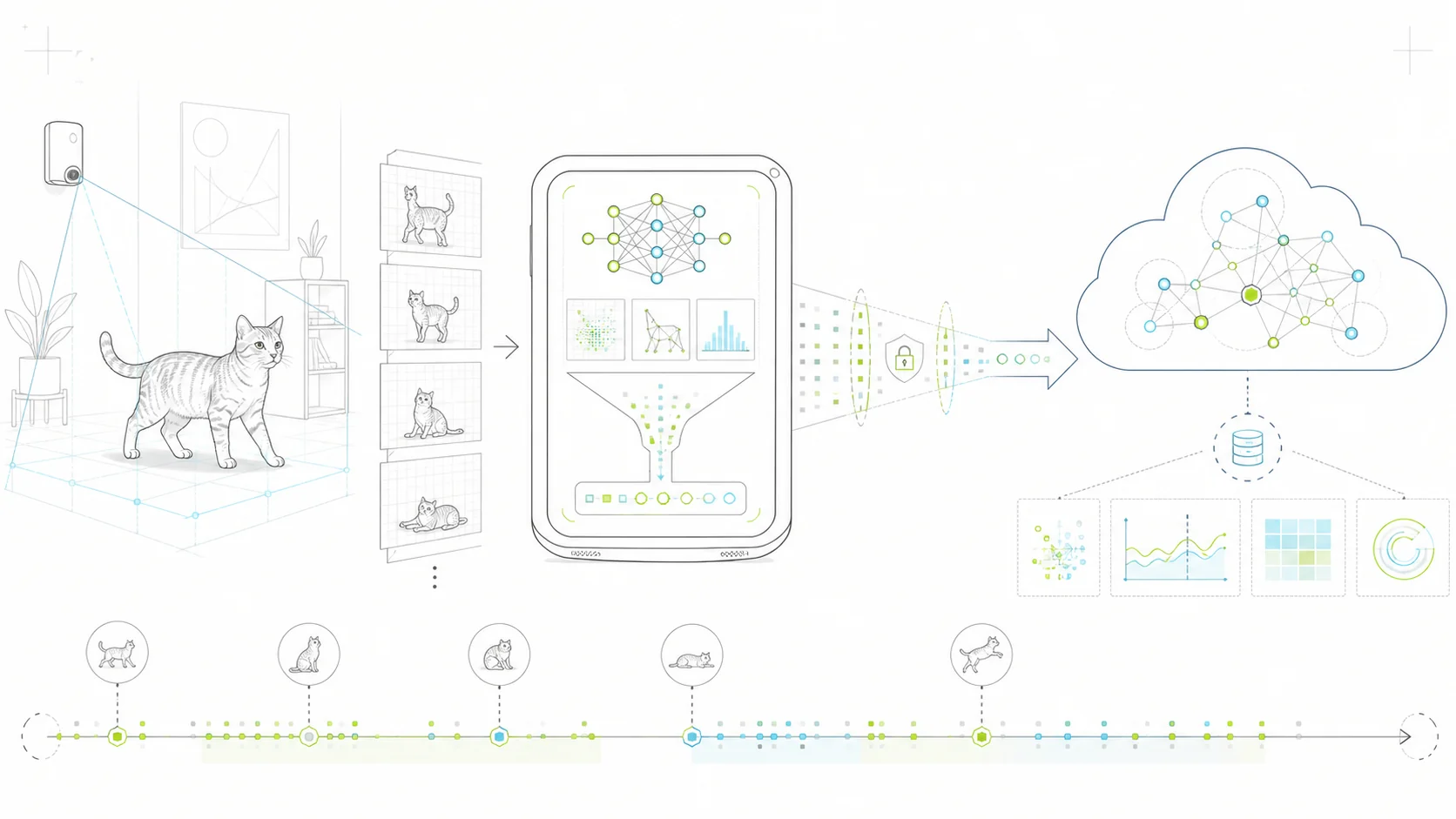
A home camera notices movement at 2 a.m. It could upload the video and wait for a server to decide whether a cat entered the room. It could also make that first decision on the device, keep a short event clip, and send only the result the owner needs.
That choice is the difference between edge and cloud AI. Many products need both, with each piece of work placed where it can run reliably and with the least unnecessary data movement.
The short version
Edge AI runs inference on or near the device collecting the data. Cloud AI sends data to remote infrastructure for processing. A hybrid system divides the work between them.
| Requirement | Edge is a strong fit | Cloud is a strong fit |
|---|---|---|
| Immediate event response | Yes | Depends on connection and round trip |
| Operation during an outage | Possible | Limited |
| Large, frequently updated models | Constrained by hardware | Easier to provide |
| Long-term history across devices | Limited locally | Well suited |
| Raw-media minimization | Can filter before upload | Requires an upload decision first |
| Fleet-wide improvement | Harder to coordinate | Easier to centralize |
The architecture should follow the job. Cat detection and event filtering may need to happen quickly and continuously. Comparing months of history across several devices may be better suited to a cloud service.
What belongs close to the sensor
The edge is valuable when a decision is frequent, time-sensitive, or based on private raw data.
For a feline monitoring system, local tasks might include:
- deciding whether a cat is present in a frame;
- rejecting empty or unreadable footage;
- detecting a short event worth keeping;
- extracting compact behavior fields from a visible scene;
- continuing basic operation when the internet is unavailable.
Local processing can also reduce waste. An empty room does not need a full cloud inference. A device can discard irrelevant frames and retain a small event record instead.
There are limits. Edge hardware has a fixed memory budget, thermal envelope, and power profile. Autoregressive models generate one token after another, so verbose output can become a real systems cost. A small model with an unnecessarily long response may still be too slow for the job.
What belongs in the cloud
The cloud is useful when the task needs broader context or more compute than a home device can reasonably provide.
Examples include:
- comparing patterns across weeks or months;
- joining records from several authorized devices;
- running a larger model for a difficult, infrequent case;
- updating knowledge and improving fleet-wide behavior;
- delivering history securely to an owner's account.
Cloud services also make maintenance easier. A model can be updated centrally without replacing hardware in every home. The tradeoff is dependence on networking, server availability, operating cost, and a clear policy for transmitted data.
Privacy depends on the whole path
“Runs locally” is useful, but it is not a complete privacy claim. A device might perform local inference and still upload every clip. A cloud system might send only a small, encrypted feature record and delete it quickly.
The questions that matter are concrete:
- What raw data is captured?
- What is processed locally?
- What leaves the device, and why?
- How long is each form of data retained?
- Can the owner review and delete it?
Edge processing creates an opportunity to minimize data before transmission. Product policy and implementation determine whether that opportunity is used.
Output length is part of edge performance
Our 2026 preprint gives a useful example. Catellect-VL-2B first learned to produce a full structured JSON report. A later training stage represented the same behavior fields in a shorter fixed-order format, which could be deterministically restored to JSON.[1]
On an RK3576 edge processor, the compact-output version ran 2.51 times faster than the full-JSON version of the same 2-billion-parameter model. The compact model reached 80.62% average behavior-field accuracy on the held-out benchmark, compared with 83.63% for the full structured-output model.[1]
This is a research result under the paper's evaluation setup. It is not a universal speed claim for every device or workload. It demonstrates a practical point: deployment depends on the model, the hardware, and the amount of output the system asks the model to generate.
Shorter output also encourages a better product boundary. The device can report observable fields and confidence rather than improvising a long explanation. A separate layer can then add history or user-facing context where appropriate.
A sensible hybrid flow for the home
A hybrid feline system could work like this:
- The home device detects a cat and extracts a compact event record.
- Irrelevant frames are dropped locally; selected clips stay local unless the owner enables upload.
- The cloud receives an authorized event summary and adds longer-term history.
- The app shows the evidence, uncertainty, and change from the cat's baseline.
This division is useful because the edge knows the immediate scene while the cloud can know the longer story. Either side can fail, so the product should degrade gracefully. A network outage should not stop basic local detection. A local device should not pretend it has months of history when that history is unavailable.
What this means for Catellect
Catellect's research supports local, structured feline behavior perception. The product architecture can use that capability to filter events and preserve immediate context, while cloud services handle authorized history, coordination, and heavier reasoning.
The boundary should remain visible to the owner. Local processing, media retention, upload controls, and cloud history are separate choices. Making those choices explicit is more trustworthy than placing an “edge AI” label on the box.
For Catellect, this points to a hybrid design: immediate perception at home, selective transmission, and longer-term analysis only when the owner permits it.
Sources
[1] Catellect-VL-2B: A Vision-Language Model for Edge-Based Feline Behavior Understanding
FAQ
Does edge AI work without the internet?
It can, if the required model and software are stored on the device. Cloud history, remote access, and account features may still need a connection.
Is edge AI always more private?
No. It can reduce raw-data transmission, but privacy also depends on storage, upload behavior, retention, access controls, and deletion.
Why not run every task locally?
Home hardware has limits, and some jobs benefit from larger models or long-term data across devices. Local inference is best reserved for work where speed, continuity, or data minimization matters.
Why does output format affect speed?
Many language models generate tokens sequentially. A compact representation requires fewer generated tokens than a verbose JSON document, which can reduce inference time on constrained hardware.